How to Read a Function in Matlab From Another Folder
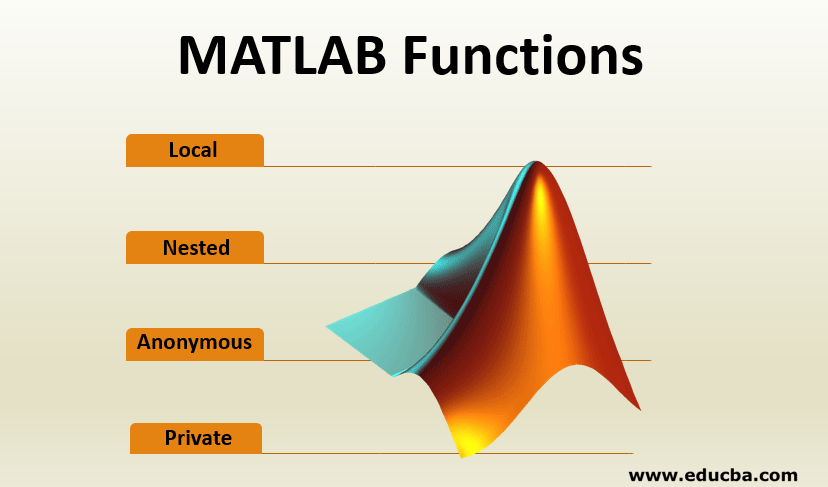
Introduction to MATLAB Functions
MATLAB Functions are written with various lines of code that relate one variable with some other variable, and each output is related exactly to one particular input that forms an important function of whatever programming language. In MATLAB environment, they are stored in a sure file similar script files, etc. They can have more than one input argument and can also render more than than one output argument. They operate on the divers variables in their predefined workspace, known as the local workspace.
Types of Functions in MATLAB
In Matlab, functions tin exist created or defined using the below syntax:
function [o1,o2, ..., oN] = myfun(i1,i2,i3, ..., iN)
Here my fun is the function proper noun that accepts the input arguments i1,i2..iN and returns output o1,o2…on. The higher up argument should be first-line while declaring the part. At that place are some rules which need to be followed for valid function names and saving the role:
- The part name, which begins with alphabets and can contain number, characters or underscores, are considered valid.
- We tin can save the role in a function file that contains office definitions, and the name of the file must lucifer the first part name in the file.
- We tin can also salvage the office, which contains function definitions and commands. Functions should be present at the end of the file, and the script file proper name cannot take the aforementioned name as the function in the file.
The finish keyword should exist used to indicate the end of the function. It is required when whatever function in the file contains a nested function or function used as a local function within the script and role file. Functions work in scripts in R2016b or later. There are several types of functions used in MATLAB. They are as follows:
1. Anonymous Part
It is the office that is not stored in a program file, but it is associated with the variable whose data type is function_handle. Information technology is defined in a single argument and has any number of input or output arguments. The syntax can be written as:
Fun=@(argumentlist)expression
Example:
mul=@(x,y) x*y;
                res1=mul(2,3)
                res2=mul(4,3)
                res3=mul(4,5)
When nosotros run the output, nosotros become the following effect:
res1=6
res2=12
res3=20
We can write anonymous functions with no inputs or multiple inputs and outputs. If the function has no input then we tin can utilise an empty parenthesis to telephone call the bearding function. Some of the examples are
i. curr= @() datestr(now);
d = curr()
Output: d= 22-Oct-2019 11:02:47
two. myfun=@(x,y)(10+y);
x=4
y=seven
z=myfun(x,y)
Output: z=eleven
2. Local Functions
Whatever function file contains a primary function that appears in the kickoff line of the code. They are visible to functions in other files and tin can be called in the command line. Other functions that are nowadays in the file are called local functions. They cannot exist called from the command line and are seen to a parent or master part and functions written in the same file. They are besides known as sub-functions. They are equivalent to subroutines equally used in some other programming linguistic communication. They can also be written in script files as long as they appear after the last line of the script code.
function [avg, med] = mystats(y)
                a= length(y);
                avg = mymean(y,a);
                med = mymedian(y,a);
                end
function a = mymean(v,northward) ---- Case of a local role
                a = sum(v)/north;
                end
3. Nested Functions
Functions that are defined within another part or parent office are called nested functions. They can use or modify the variables that are defined in the parent function. They are divers within the scope of the part and tin can access the workspace in which they are defined. There are sure requirements that every nested part should follow:
- All the functions do non require the end statement. However, to nest any function end statement should be written for every function.
- Nosotros cannot ascertain nested functions within any control statements similar if-else, switch instance, etc.
- Nested functions can exist called straight by name or using whatsoever part handle.
function current
                nestfun1
                nestfun2
                role nestfun1
                x = 7;
                end
                function nestfun2
                x = 4;
                end
4. Private Functions
They are the functions that are visible just to a express group of functions. They reside in sub-functions and are denoted using the keyword "private". They are merely visible to functions that are present in the parent folder or the functions in the folder immediately above the private subfolder. They are useful when we want to limit the scope of the function. We cannot call the private functions from the command line or from the functions exterior of the parent folder.
Lawmaking:
office priv
                disp("Hello ")
Change the folder that contains a private folder and alter the file name to nowadays
function present
priv
Alter the folder to whatever location and call the present function
present
Output:" How-do-you-do"
Conclusion – MATLAB Functions
MATLAB Functions tin exist used for several tasks and scenarios. They class an integral part of whatsoever programming language. They can be accessed globally by using global variables or private functions if we want some data or content to exist private. They are used in every organization for the business needs to fulfill the demands.
Recommended Articles
This is a guide to the MATLAB Functions. Hither we talk over the Introduction of the MATLAB Functions and the Types of Functions. You can likewise become through our other suggested manufactures to learn more –
- Bessel Functions in MATLAB
- Anonymous Functions in Matlab
- Math Functions in C#
- Transfer Functions in Matlab
armstrongalwastion.blogspot.com
Source: https://www.educba.com/matlab-functions/

Publicar un comentario for "How to Read a Function in Matlab From Another Folder"