When Can I Smoke Again After Wisdom Teeth Removal
| Wisdom molar | |
|---|---|
 Wisdom teeth | |
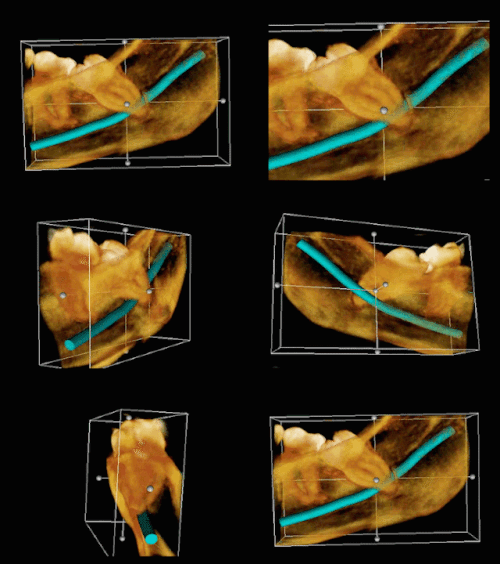 3D CT of an impacted wisdom tooth near the inferior alveolar nerve | |
| Identifiers | |
| MeSH | D008964 |
| TA98 | A05.1.03.008 |
| TA2 | 911 |
| FMA | 321612 |
| Anatomical terminology [edit on Wikidata] | |
A tertiary molar, usually called a wisdom tooth, is one of the three molars per quadrant of the man dentition. It is the well-nigh posterior of the three. The historic period at which wisdom teeth come up through (erupt) is variable,[ane] but this generally occurs between late teens and early twenties.[2] Most adults have iv wisdom teeth, one in each of the 4 quadrants, only it is possible to accept none, one to three, or more than four, in which case the extras are chosen supernumerary teeth.
Wisdom teeth may get stuck (impacted) against other teeth if there is not enough infinite for them to come through unremarkably.[3] Impacted wisdom teeth are all the same sometimes removed for orthodontic treatment, assertive that they move the other teeth and crusade crowding, though this is not held anymore as true.[4] Impacted wisdom teeth may suffer from tooth disuse if oral hygiene becomes more hard. Wisdom teeth which are partially erupted through the gum may also cause inflammation[3] and infection in the surrounding gum tissues, termed pericoronitis. Some more conservative treatments, such as operculectomies, may exist fitting for some cases, all the same impacted wisdom teeth are commonly extracted as treatment for these problems, many times before these problems even occur. Some institutions and researchers oppose this preventive removal of disease-costless impacted wisdom teeth, among them the Britain's National Health Service and National Found for Health and Care Excellence.[four] [5] [vi]
Structure [edit]
Tooth morphology [edit]
Morphology of wisdom teeth can be variable.
Maxillary (upper) tertiary molars commonly have a triangular crown with a deep key fossa from which multiple irregular fissures originate. Their roots are commonly fused together and can exist irregular in shape.
Mandibular tertiary molars are the smallest molar teeth in the permanent dentition. The crown usually takes on a rounded rectangular shape that features four or five cusps with an irregular crevice pattern. Roots are profoundly reduced in size and tin be fused together.[7]
Dental notation [edit]
In that location are several notation systems used in dentistry to identify teeth, including the Palmer/Zsigmondy Organisation. Under the Palmer/Zsigmondy arrangement, the correct and left maxillary wisdom teeth are represented by 8┘ and └8, whereas 8┐and ┌8 symbols are used to correspond the correct and left mandibular wisdom teeth. Another commonly used method of dental note is the FDI notational system. Under this organisation, the correct and left maxillary third molars are represented by 18 and 28 respectively and the right and left mandibular third molars are numbered equally 48 and 38. According to the Universal Numbering System the right and left upper wisdom teeth are labelled 1 and 16 and the right and left lower wisdom teeth are assigned 17 and 32 respectively.
Variation [edit]
Agenesis of wisdom teeth differs by population, ranging from practically zero in Aboriginal Tasmanians to nigh 100% in indigenous Mexicans.[eight] [9] The difference is related to the PAX9, and MSX1 gene (and maybe other genes).[10] [11] [12] [xiii]
Age of eruption [edit]
There is significant variation between the reported age of eruption of wisdom teeth betwixt different populations.[14] For instance, wisdom teeth tend to erupt earlier in people with African heritage compared to Asian and European heritage.[14]
Generally wisdom teeth erupt most commonly between age 17 and 21.[one] Eruption may kickoff as early as age thirteen in some groups[fourteen] and typically occurs earlier the age of 25.[15] If they have non erupted by age 25, oral surgeons generally consider that the tooth will non erupt spontaneously.[2]
Root evolution can continue for up to iii years after eruption occurs.[sixteen]
Part [edit]
Anthropologists believe wisdom teeth were the evolutionary answer to man ancestors' hunter-gatherer diet, containing, amongst other things, coarse, rough food – like leaves, roots, nuts and meats.[17] [ farther caption needed ]
Clinical significance [edit]

A wisdom tooth protrudes outwards from the gumline with inflamed tissue at the back (pericoronitis; green arrow)
Wisdom teeth (often notated clinically as M3 for 3rd molar) are the about commonly impacted teeth in the human being mouth.[eighteen] Impacted wisdom teeth pb to pathology in 12% of cases.[19]
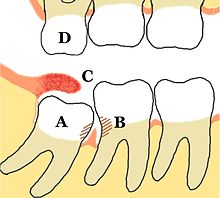
Some bug which may or may not occur with third molars: A Mesio-impacted, partially erupted mandibular third molar, B Dental caries and periodontal defects associated with both the third and second molars, caused past food packing and poor admission to oral hygiene methods, C Inflamed operculum covering partially erupted lower third molar, with accumulation of food droppings and bacteria underneath, D The upper 3rd molar has over-erupted due to lack of opposing tooth contact, and may beginning to traumatically occlude into the operculum over the lower tertiary tooth. Unopposed teeth are normally precipitous considering they take not been blunted by another tooth.

Dental 10-ray of impacted lower left wisdom tooth with a horizontal orientation
Impacted wisdom teeth are classified by the management and depth of impaction, the amount of bachelor space for tooth eruption and the amount soft tissue or os that covers them. The classification structure allows clinicians to gauge the probabilities of impaction, infections and complications associated with wisdom teeth removal.[xx] Wisdom teeth are also classified past the presence of symptoms and disease.[21]
Treatment of an erupted wisdom tooth is the same as any other tooth in the mouth. If impacted and having a pathology, such as caries or pericoronitis, treatment tin can exist dental restoration, salt water rinses, local handling to the infected tissue overlying the impaction,[22] : 440–441 oral antibiotics, operculectomy, or if those failed, extraction or coronectomy.
Mutual pathologies [edit]
Odontogenic infections are a dental complication originating inside the tooth or in close proximity to the surrounding tissues. At that place are dissimilar types of odontogenic infections which may affect impacted wisdom teeth such as periodontitis, pulpitis, dental abscess and pericoronitis.
Pericoronitis is a common pathology of impacted third molar.[23] It is an acute localized infection of the tissue surrounding the impacted wisdom teeth. Clinically the tissue appears to be blood-red, tender to touch and edematous. The mutual symptoms patients report are pain 'that ranges from irksome to throbbing to intense' and often radiates to mouth, ear or floor of the oral cavity. Moreover, swelling of the cheek, halitosis and trismus can occur.[24]
Odontogenic cysts are a less mutual pathology of the impacted wisdom tooth. They are described equally 'cavities filled with liquid, semiliquid or gaseous content with odontogenic epithelial lining and connective tissue on the outside'. Nevertheless, studies take found cysts to exist prevalent in a small percent of impacted wisdom teeth that are extracted. The most common types associated with impacted 3rd molars are radicular cysts, dentigerous cysts and odontogenic keratocysts.[25]
Oral hygiene [edit]
Exercise and maintenance of proficient oral hygiene can assistance preclude and control some wisdom tooth pathologies. In addition to twice daily toothbrushing, interdental cleaning is recommended to ensure plaque build doesn't occur in interdental areas. At that place are various products bachelor for this – dental floss and interdental brushes existence the well-nigh mutual.
Removal of impacted wisdom teeth [edit]
Removal of asymptomatic impacted wisdom teeth with the absence of illness and no evidence of local infection as a prophylactic method has been disputed within the dental community for a long fourth dimension. There is bereft, reliable scientific evidence for dental wellness professionals and policy makers to determine if asymptomatic disease-gratis impacted wisdom teeth should be removed. Therefore, the decision will depend on a combination of clinical expertise and patient preference. If the tooth is retained, regular bank check-ups to identify whatever problems that may occur is recommended. Considering the lack of quality evidence at present, more than long-term studies need to be undertaken to obtain a reliable scientific conclusion.[26]
Mandibular 3rd tooth surgery recovery [edit]
Platelet-rich fibrin (PRF) is a postoperative method used to heal the alveolar socket following the removal of the mandibular tertiary molar. PRF is a second generation result of the isolation of platelets, white claret cells, stem cells and growth factors from blood samples. Studies accept shown that when used there are improvements in pain sensations, swelling and a decreased risk of developing dry out socket. This method was shown to but reduce symptoms and is not completely preventive. To appointment there is no clear correlation betwixt the utilise of PRF after a mandibular 3rd molar removal surgery and the recovery of jaw spasms, bone restoration and soft tissue healing. Further studies with larger study samples are needed to validate current theories.[27]
Prognosis [edit]
Virtually a third of symptomatic unerupted wisdom teeth accept been shown to partially erupt and be not-functional or non-hygienic. Studies have also shown that xxx% to 60% of people with a previously asymptomatic impacted wisdom teeth will have an extraction of at least ane of them in 4 to 12 years from diagnosis.[28]
Risk factors of junior alveolar nerve impairment [edit]
Temporary and permanent junior alveolar nervus (IAN) impairment is a known complication of the surgical removal of impacted lower third molars, happening in 1 in 85 and 1 in 300 extractions, respectively. Studies take shown that certain run a risk factors may increase the likelihood of IAN damage. Proximity of the impacted third molar root to the mandibular canal, which can be seen in radiographs, has been shown to be a high-take a chance factor for IAN impairment. Alongside this, the depth of impaction of the tooth, surgical technique and surgeons experience are all contributing adventure factors for IAN impairment during this procedure. Careful case-by-instance consideration is crucial to avoid this risk.[29]
Lower anterior teeth crowding [edit]
Lower inductive teeth crowding has been a common discussion amid the orthodontic customs for decades. In the 1970's it was idea that unerupted wisdom teeth produced a forward directed strength which would cause crowding of the inductive segment. Recent research has shown that there is no agreed opinion and that the cause is due to a variety of factors. This includes dental factors such equally tooth crown size and principal tooth loss. Skeletal factors which include growth of the maxilla and mandible and the presence of malocclusions. General factors, including the historic period and gender of the patient. Overall, recent inquiry has suggested that wisdom teeth solitary do non cause crowding of teeth. [30]
History [edit]
Although formally known as third molars, the mutual name is wisdom teeth because they appear so belatedly – much later than the other teeth, at an age where people are presumably "wiser" than as a child, when the other teeth erupt.[31] The term probably came as a translation of the Latin dens sapientiae. Their eruption has been known to cause dental bug for millennia; information technology was noted at to the lowest degree every bit far back equally Aristotle:
The last teeth to come in man are molars called 'wisdom-teeth', which come at the historic period of twenty years, in the case of both sexes. Cases accept been known in women upwards of eighty years erstwhile where at the very close of life the wisdom-teeth have come up, causing great pain in their coming; and cases have been known of the similar miracle in men too. This happens, when it does happen, in the case of people where the wisdom-teeth have not come upwardly in early years.
—Aristotle, The History of Animals [32]
The oldest known impacted wisdom tooth belonged to a European adult female who lived between thirteen,000 and 11,000 BC in the Magdalenian menses.[33] Tooth impaction was relatively rare prior to the modern era. With the Industrial Revolution, the condition became ten times more common due to the consumption of softer foods during childhood,[34] leading to smaller (shorter) jaws in the adults, without enough room for the wisdom teeth to erupt, and then, to impacted wisdom teeth.[35]
See too [edit]
References [edit]
- ^ a b McCoy JM (September 2012). "Complications of retention: pathology associated with retained 3rd molars". Atlas of the Oral and Maxillofacial Surgery Clinics of N America. 20 (2): 177–95. doi:10.1016/j.cxom.2012.06.002. ISBN978-1455747887. PMID 23021395.
- ^ a b Swift JQ, Nelson WJ (September 2012). "The nature of 3rd molars: are third molars different than other teeth?". Atlas of the Oral and Maxillofacial Surgery Clinics of North America. xx (2): 159–62. doi:ten.1016/j.cxom.2012.07.003. PMID 23021392.
- ^ a b "Wisdom Teeth And Orthodontic Treatment: Should I exist worried?". Orthodontics Australia. 2020-01-25. Retrieved 2020-11-19 .
- ^ a b Friedman JW (September 2007). "The prophylactic extraction of third molars: a public health hazard". American Journal of Public Health. 97 (nine): 1554–9. doi:10.2105/AJPH.2006.100271. PMC1963310. PMID 17666691.
- ^ "one Guidance | Guidance on the Extraction of Wisdom Teeth | Guidance | NICE". www.nice.org.great britain . Retrieved 2019-12-03 .
- ^ "Opposition to Prophylactic Removal of Third Molars (Wisdom Teeth)". www.apha.org . Retrieved 2019-12-02 .
- ^ Berkovitz BK, Holland GR, Moxham BJ (2017). Oral Anatomy, Histology and Embryology fifth edition. Elsevier. pp. 25–26.
- ^ Rozkovcová East, Marková M, Dolejsí J (1999). "Studies on agenesis of third molars amongst populations of dissimilar origin". Sbornik Lekarsky. 100 (2): 71–84. PMID 11220165.
- ^ Sujon MK, Alam MK, Rahman SA (2016-08-31). "Prevalence of Third Molar Agenesis: Associated Dental Anomalies in Non-Syndromic 5923 Patients". PLOS ONE. 11 (8): e0162070. Bibcode:2016PLoSO..1162070S. doi:10.1371/journal.pone.0162070. PMC5006966. PMID 27580050.
- ^ Pereira TV, Salzano FM, Mostowska A, Trzeciak WH, Ruiz-Linares A, Chies JA, et al. (April 2006). "Natural selection and molecular evolution in primate PAX9 gene, a major determinant of tooth evolution". Proceedings of the National Academy of Sciences of the The states of America. 103 (15): 5676–81. Bibcode:2006PNAS..103.5676P. doi:x.1073/pnas.0509562103. JSTOR 30050159. PMC1458632. PMID 16585527.
- ^ Bonczek O, Balcar VJ, Šerý O (November 2017). "PAX9 gene mutations and tooth agenesis: A review". Clinical Genetics. 92 (5): 467–476. doi:10.1111/cge.12986. PMID 28155232. S2CID 29589974.
- ^ Lidral Ac, Reising BC (Apr 2002). "The role of MSX1 in human tooth agenesis". Journal of Dental Research. 81 (4): 274–8. doi:10.1177/154405910208100410. PMC2731714. PMID 12097313.
- ^ Tallón-Walton Five, Manzanares-Céspedes MC, Carvalho-Lobato P, Valdivia-Gandur I, Arte Due south, Nieminen P (May 2014). "Exclusion of PAX9 and MSX1 mutation in 6 families affected past molar agenesis. A genetic study and literature review". Medicina Oral, Patologia Oral y Cirugia Bucal. 19 (3): e248-54. doi:10.4317/medoral.19173. PMC4048113. PMID 24316698.
- ^ a b c Tsokos M (2008). Forensic Pathology Reviews 5. Springer Science & Business Media. p. 281. ISBN9781597451109.
- ^ "Wisdom Teeth". American Clan of Oral and Maxillofacial Surgeons. Retrieved 2019-11-19 .
They come in between the ages of 17 and 25, a time of life that has been called the "Historic period of Wisdom."
- ^ Kaveri GS, Prakash S (June 2012). "Third molars: a threat to periodontal wellness??". Periodical of Maxillofacial and Oral Surgery. eleven (two): 220–three. doi:10.1007/s12663-011-0286-10. PMC3386422. PMID 23730073.
- ^ Cooper R (February 5, 2007). "Why Exercise We Have Wisdom Teeth?". Scienceline.org. Archived from the original on 2016-05-03.
- ^ "Which teeth are nigh often impacted?". Healthline. 22 May 2018.
- ^ Stanley Hour, Alattar One thousand, Collett WK, Stringfellow HR, Spiegel EH (March 1988). "Pathological sequelae of "neglected" impacted third molars". Periodical of Oral Pathology. 17 (3): 113–7. doi:10.1111/j.1600-0714.1988.tb01896.x. PMID 3135372.
- ^ Juodzbalys G, Daugela P (July 2013). "Mandibular 3rd molar impaction: review of literature and a proposal of a nomenclature". Journal of Oral & Maxillofacial Research. 4 (2): e1. doi:x.5037/jomr.2013.4201. PMC3886113. PMID 24422029.
- ^ Dodson TB (September 2012). "The management of the asymptomatic, disease-free wisdom molar: removal versus retention". Atlas of the Oral and Maxillofacial Surgery Clinics of North America. 20 (2): 169–76. doi:ten.1016/j.cxom.2012.06.005. PMID 23021394.
- ^ Newman MG, Takei HH, Klokkevold PR, Carranza FA (2012). Carranza's Clinical Periodontology. Elsevier Saunders. ISBN978-1-4377-0416-7.
- ^ López-Píriz R, Aguilar L, Giménez MJ (March 2007). "Management of odontogenic infection of pulpal and periodontal origin". Medicina Oral, Patologia Oral y Cirugia Bucal. 12 (2): E154-9. PMID 17322806.
- ^ López-Píriz R, Aguilar L, Giménez MJ (March 2007). "Management of odontogenic infection of pulpal and periodontal origin". Medicina Oral, Patologia Oral y Cirugia Bucal. 12 (2): E154-9. PMID 17322806.
- ^ Borrás-Ferreres J, Sánchez-Torres A, Gay-Escoda C (December 2016). "Malignant changes developing from odontogenic cysts: A systematic review". Journal of Clinical and Experimental Dentistry. 8 (5): e622–e628. doi:10.4317/jced.53256. PMC5149102. PMID 27957281.
- ^ Ghaeminia, Hossein; Nienhuijs, Marloes El; Toedtling, Verena; Perry, John; Tummers, Marcia; Hoppenreijs, Theo Jm; Van der Sanden, Wil Jm; Mettes, Theodorus G. (2020-05-04). "Surgical removal versus retention for the management of asymptomatic disease-free impacted wisdom teeth". The Cochrane Database of Systematic Reviews. 5: CD003879. doi:ten.1002/14651858.CD003879.pub5. ISSN 1469-493X. PMC7199383. PMID 32368796.
- ^ Xiang, Xu; Shi, Ping; Zhang, Ping; Shen, Jun; Kang, Jian (2019-07-25). "Impact of platelet-rich fibrin on mandibular third molar surgery recovery: a systematic review and meta-analysis". BMC Oral Wellness. xix (one): 163. doi:10.1186/s12903-019-0824-3. ISSN 1472-6831. PMC6659259. PMID 31345203.
- ^ Dodson, Thomas B.; Susarla, Srinivas Thousand. (2014-08-29). "Impacted wisdom teeth". BMJ Clinical Evidence. 2014: 1302. ISSN 1752-8526. PMC4148832. PMID 25170946.
- ^ Kang, F.; Sah, One thousand.G.; Fei, G. (Feb 2020). "Determining the risk human relationship associated with inferior alveolar nervus injury following removal of mandibular third tooth teeth: A systematic review". Journal of Stomatology, Oral and Maxillofacial Surgery. 121 (1): 63–69. doi:ten.1016/j.jormas.2019.06.010. PMID 31476533. S2CID 201805670.
- ^ Stanaitytė, Rūta; Trakinienė, Giedrė; Gervickas, Albinas (2014). "Do wisdom teeth induce lower anterior teeth crowding? A systematic literature review". Stomatologija. 16 (1): 15–eighteen. ISSN 1822-301X. PMID 24824055.
- ^ "Wisdom tooth". Oxford English Dictionary. Oxford: Oxford University Printing. 1989. ISBN0-19-861186-2.
- ^ Aristotle (2015). The History of Animals . Translated by D'Arcy Wentworth Thompson. Aeterna Printing. p. 49.
- ^ "Magdalenian Girl is a woman and therefore has oldest recorded instance of impacted wisdom teeth" (Press release). Field Museum of Natural History. March 7, 2006. Retrieved Feb fifteen, 2013.
- ^ "What teeth reveal nearly the lives of modern humans". Retrieved 2018-ten-22 .
- ^ von Cramon-Taubadel N (December 2011). "Global homo mandibular variation reflects differences in agricultural and hunter-gatherer subsistence strategies". Proceedings of the National Academy of Sciences of the U.s.. 108 (49): 19546–51. Bibcode:2011PNAS..10819546V. doi:10.1073/pnas.1113050108. PMC3241821. PMID 22106280.
External links [edit]
- National Institute of Clinical Health and Excellence Guideline to Wisdom teeth removal
- Wisdom tooth extraction WebMD article
armstrongalwastion.blogspot.com
Source: https://en.wikipedia.org/wiki/Wisdom_tooth

Publicar un comentario for "When Can I Smoke Again After Wisdom Teeth Removal"